Need to Know About Tulip Setting Engagement Rings
Why Tulip Setting Engagement Rings Are a Timeless Choice
The setting that holds a diamond the way a flower holds light, and why it changes everything.
Most people, when they start thinking about what makes an engagement ring really beautiful, end up focusing on the diamond. The cut, the carat, the colour, all that. But what they don't always factor in is what keeps that diamond right where it belongs, and also how the setting sort of changes everything about the way the stone feels, looks, and catches light. This is where tulip setting engagement rings come in, and once you've seen one in person, it gets pretty hard to see a regular prong setting the same way again.
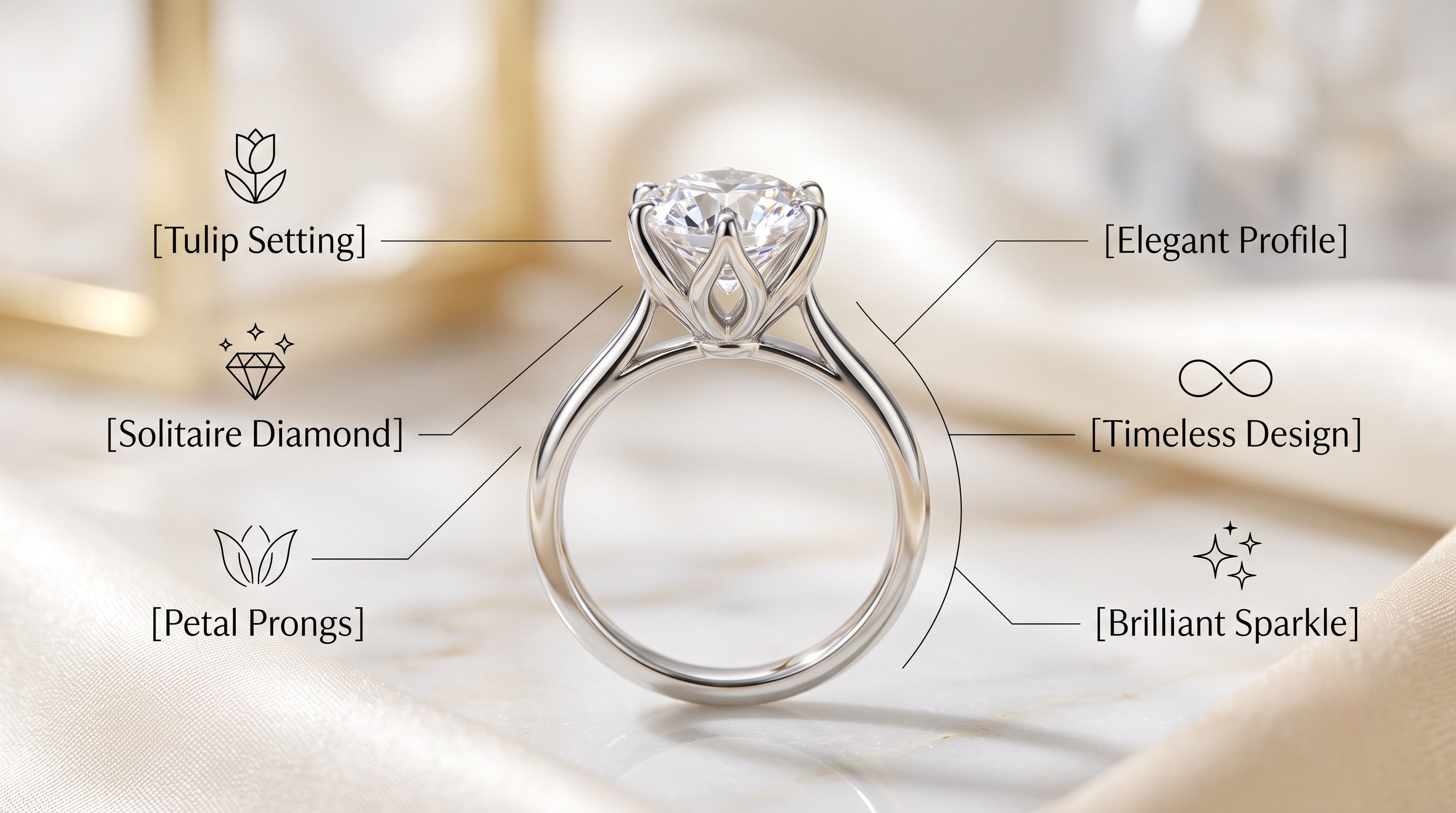
The tulip setting takes its name from what it looks like, more or less. The prongs that hold the stone are shaped and gently curved so they resemble tulip petals in bloom, they arch inward toward the base of the diamond, then curve back out again beneath it. That makes this kind of cradle that feels both structural and kind of organic too, not in a "just pretty" way. It isn't ornamentation for its own sake; the curve of those petal prongs does actual work, lifting the stone a bit higher, keeping it held more securely, and giving it a framing that makes the setting part of the overall design, not something tacked on. Tulip setting engagement rings are that rare sort of ring where the stone's neighbourhood, the architecture around it, is just as carefully planned as the diamond itself.
The Tulip Setting Ring: Where Nature Meets Fine Jewellery
A tulip setting ring is built around a central idea that the prongs holding the stone shouldn't be just side notes, or something you do at the end. In a more ordinary four or six-prong setting, the prongs are functional, you know, they grip the stone and then simply step back. But in a tulip setting, those same prongs get reshaped into curved, petal-like forms that sweep up and inward toward the stone's girdle. When you look at it from the side, the ring can almost feel biological, like a little flower closed around something precious. And if you view it from above, the centre stone looks like it's floating inside a sort of crown, made of twisting metal that borders it without really blocking it.
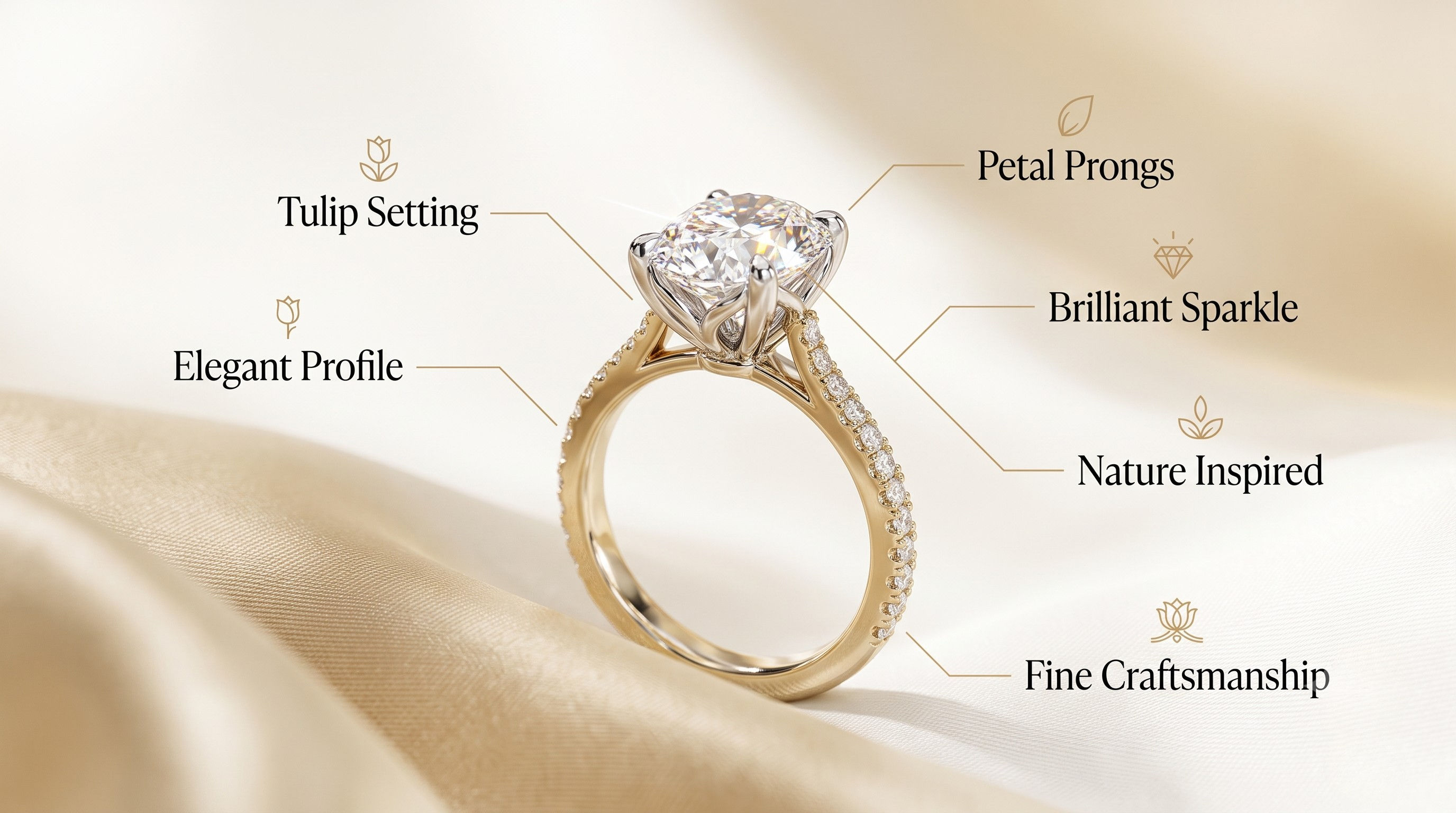
This isn't only a visual trick. The curved prong design in tulip setting engagement rings helps spread pressure more evenly around the stone's edge, better than straight prongs would. The organic shape is also nice because it doesn't really have harsh angles that catch on fabric or snag clothing; it wears as well as it looks. And since those little petals curve under the stone, instead of just gripping from above, the diamond kind of looks like it's sitting inside the ring, not sitting on top of it. That feeling of joining stone and setting is the part people can't always put a name to, but you can tell right away, the first time you hold one.
Why Tulip Setting Engagement Rings Suit Every Stone Shape
One of the practical strengths of the tulip setting is how well it adapts. Unlike some settings that work best with a specific stone shape, tulip setting engagement rings are equally at home with round brilliants, ovals, pear cuts, cushion cuts, and marquise stones. The petal prongs adjust to hold different girdle shapes without losing their defining character. What changes is the way the tulip frames each stone:
- A round brilliant sits inside its petal crown with a particular symmetry
- An oval creates a longer, more graceful silhouette
- A pear cut or marquise gives the tulip setting an almost Art Nouveau quality, as though the stone is a blossom and the petals are growing up to meet it
Tulip Setting Diamond Ring: The Classic at Its Best
A round brilliant in a tulip setting is where this style feels most fully itself. The tulip setting diamond ring with a round stone gives you perfect radial symmetry; the four or six petal prongs space themselves evenly around the stone's circumference, creating a crown that looks as intentional from every angle as it does from directly above. The round brilliant's 58 facets catch light, in every direction sort of, then the tulip setting curves do their part and let that glow escape without a fight from the sides just as much as from above. These two elements seem to work together kind of as a unit, so the ring feels alive when it moves or turns.
Tulip Solitaire Setting: Simplicity That Doesn't Compromise
A tulip solitaire setting is for people who want one stone, no distraction, and a setting that earns its place without needing extra diamonds to justify itself. The single-stone tulip is deceptively minimal from above: a stone, a band, and what appears to be a simple prong hold. It's only when you turn the ring to the side that the tulip's character fully reveals itself: those curved petals arching beneath the stone, giving the ring a depth and intentionality that a standard solitaire setting rarely achieves.
Tulip Cathedral Setting: Height, Drama, and Floral Architecture
When the tulip setting is combined with a cathedral base, where the band rises in arches to meet the setting, the result is one of the most dramatic profiles in engagement ring design. A tulip cathedral setting lifts the stone high above the finger on sweeping metal arches, while the petal prongs create a floral crown at the top. From the side, the ring has an almost architectural quality, cathedral arches below, flower petals above, which makes it one of the most striking ring silhouettes available. It's a choice for someone who wants their ring to be genuinely seen.
Oval Cathedral Engagement Ring in a Tulip Setting
An oval cathedral engagement ring in a tulip setting is probably the most requested pairing at Layla Diamonds, and it isn't hard to see why. The oval stone's stretched outline gives this subtle, graceful lengthening on the finger; the cathedral arches add some elevation and a bit of drama, and the tulip prongs hold the piece with a kind of botanical accuracy. Honestly, all three parts, the form, the base, the crown, seem to point in the same architectural way, so the ring comes off as fully planned, not sort of pieced together from separate choices.
Tulip Engagement Ring: The Detail That Rewards Looking Closely
What makes a tulip engagement ring different from every other setting is the moment you really notice it. Most folks who meet it for the first time don't immediately put a name to what they're seeing; they just feel the ring looks off in a way they can't quite pin down. Then, if someone tilts it a little sideways, you suddenly catch the petals, and everything sort of clicks. This thing, a ring that opens up more as you look closer, isn't common in fine jewellery at all. It feels especially attractive to people who want a band that keeps surprising them, not just something that sits there.
What Makes Tulip Setting Engagement Rings Worth Choosing
Beyond the aesthetics, tulip setting engagement rings offer practical advantages that matter over a lifetime of daily wear:
- The curved prongs, because they have no sharp edges, are gentler on skin and fabric than standard prongs
- The way the petals cradle the stone from below means the setting has more contact with the diamond's pavilion, providing a genuinely secure grip without needing to clamp down from above
- Because the tulip prongs are thicker at the base and taper toward the stone's edge, they wear more evenly over time than fine straight prongs that can thin and weaken at their tips
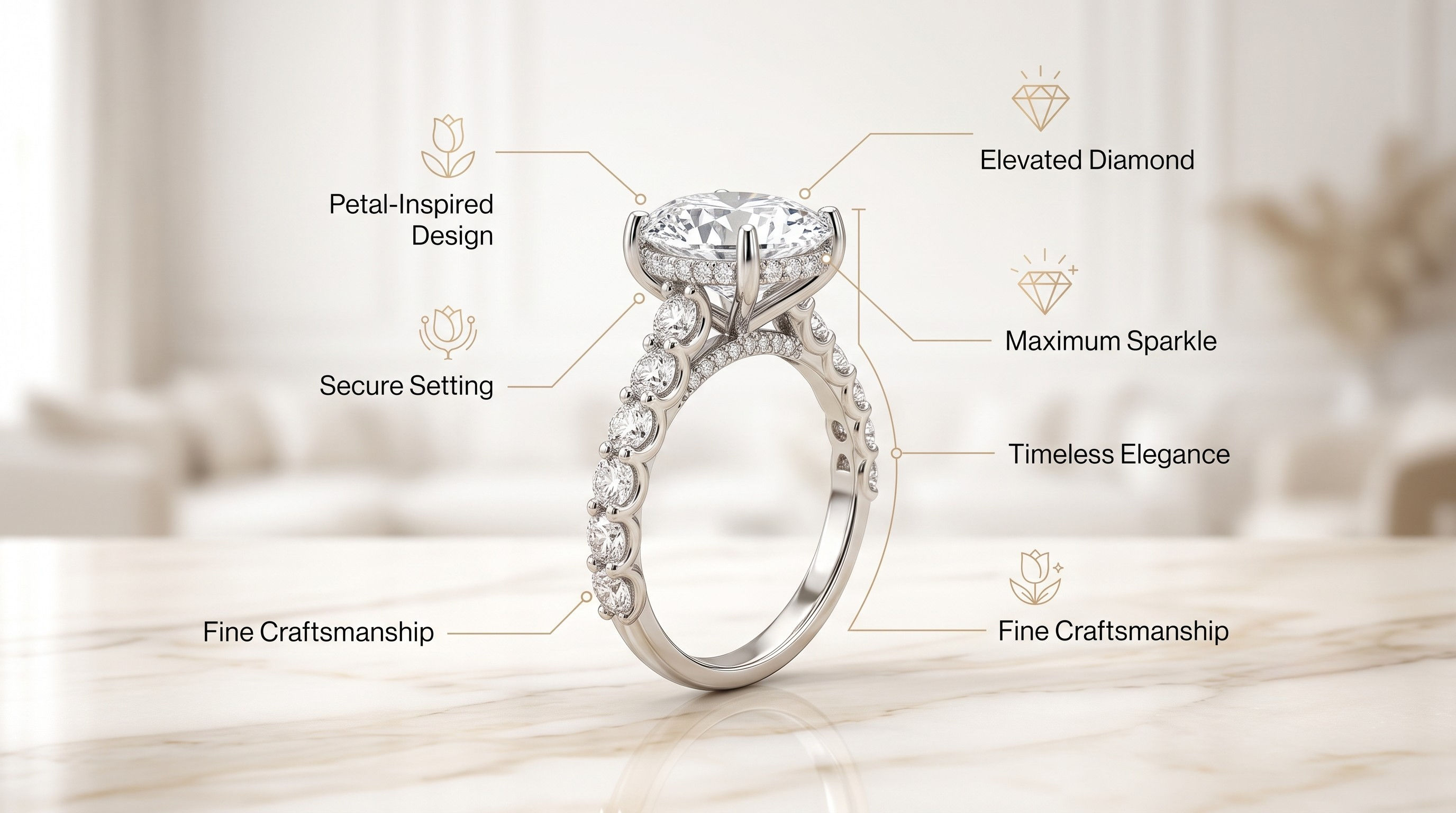
There is also something to be said for what tulip setting engagement rings communicate. A standard prong setting says: this is a diamond, held in place. A tulip setting says: this is a diamond, held as if it matters, as if the ring itself has some feeling about the stone it's carrying.
That sounds like a small thing. It isn't. The emotional charge of fine jewellery lives almost entirely in those kinds of details, in the sense that something was made with attention rather than just competence.
If you've been looking at tulip setting engagement rings and wondering whether they're right for you, the answer is almost always yes, provided you want a ring that does more than hold a stone. They suit people who notice the detail in things, who appreciate when something has been made with more thought than was strictly necessary. People who, when they find a ring they love, love it for reasons they can't entirely explain. Which is, if we're honest, how the best rings always tend to work.
Choosing Your Tulip Setting Engagement Ring
- The petals do actual work. Curved prongs lift the stone higher, hold it more securely, and frame it as part of the design — not an afterthought.
- It suits every stone shape. Round, oval, pear, cushion, marquise, the petal prongs adjust without losing their defining character.
- Solitaire tulip is deceptively minimal. Clean from above, full of character from the side, the depth reveals itself when you turn the ring.
- Cathedral tulip is the most dramatic. Arches below, petals above, a silhouette for someone who wants their ring to be genuinely seen.
- The oval cathedral is the most requested. Three elements: form, base, and crown, all pointing in the same architectural way.
- It wears better than standard prongs. No sharp edges, more contact with the pavilion, and prongs that taper evenly over time.
Find Your Tulip Setting Engagement Ring
At Layla Diamonds, every tulip setting engagement ring is made with the same attention the setting itself demands. Come and hold one in person; it's the only way to really understand what the petals do.
Frequently Asked Questions
1. What is a tulip setting engagement ring, like really? ▼
A tulip setting has curved prongs, sort of like little flower petals. They hold the diamond in place and also give that soft, floral look that feels very polished.
2. Are tulip setting engagement rings durable for everyday wear? ▼
Yeah, mostly. The prongs are curved kind of, in a way that gives you a more secure hold, and it's made so it feels comfortable for day to day use not only those special moments.
3. Which diamond shapes work best with a tulip setting? ▼
Honestly it fits a lot, still the oval, round, pear and marquise stones are probably the most common choices, because they settle so nicely with those petal like prongs in place.
4. What is the difference between a tulip setting and a standard prong setting? ▼
With a tulip setting, there's this floral-inspired detail underneath the diamond, not just the prongs. A standard prong setting tends to focus only on holding the stone, and that's basically it.
5. Is a tulip cathedral setting a good choice? ▼
Yes, it's pretty. It blends the tulip style with a cathedral band height, so the diamond looks more lifted and dramatic in a timeless kind of way.